Saturday, April 22, 2006

Short musical interlude from 1973

us and them
and after all
we’re only ordinary men

me and you
god only knows
it’s not what we would choose to do

forward he cried
from the rear
and the front rank died
the general sat
and the lines on the map
moved from side to side

black and blue
and who knows which is which
and who is who

up and down
but in the end
it’s only round and round

haven’t you heard
it’s a battle of words
the poster bearer cried
listen son
said the man with the gun
there’s room for you inside

down and out
it can’t be helped
but there’s a lot of it about

with without
and who’ll deny
it’s what the fighting’s all about

out of the way
it’s a busy day
i’ve got things on my mind
for want of the price
of tea and a slice
the old man died

Wednesday, April 19, 2006

Occam's razor kills a few more fairies

While I was cramming for my machine learning test last night, I came across an interesting passage on induction and Occam's razor. Induction is the red-headed stepchild of deduction, deduction being reasoning logically from firm premises to new conclusions. For instance, premises like "Guys are scum" and "You're a guy" imply the conclusion that "You are scum" as long as you believe the premises. The philosophical quest for deductive thinkers is to discover unshakeable premises and go from there. One of the most famous such premises is "I think, therefore I am."

Out here in the real world, we have no such foundational premises, or we don't know how to find them (unless someone in the know tells us, which is what revelatory religion is all about). To revelation and deduction, we add induction, which is trying to find the common thread in a dizzying array of experiences. Induction never really ends, because as far as we have seen (ha ha), the universe is a continually surprising place, and snips that common thread as fast as we can spin it. What this also means is that information we learn by induction is never unshakeable; the process of induction is a bit more risky than safe, justifiable deduction (in fact, it is famously difficult to justify induction, after Hume). We might be learning probabilities, or we might be finding red herrings, or we might be stumbling across fundamental truths. But we never really know, because we never really think that we have seen everything.

It is impossible to number the many possible theories about what we have seen and experienced. Witness the wild array of sciences that continually proliferate surrounding the physical (and theoretical and mathematical and computational) universe. We will never come to the end of them. When two theories conflict, like the gravitational theory and the gravity fairy theory, which one should we believe?

One way to decide between competing theories, not a law exactly, but a sort of heuristic, is called Occam's razor, after William of Occam (also spelled Ockham, I think). It has many paraphrases. I believe the original one was in Latin and meant literally "Do not multiply entities without cause". You could also say "The simplest explanation is the best explanation" or "Favor the shortest theory".

The idea is that you can lay out two theories, and if one explains all the things the other theory does, but also requires the existence of gravity fairies while the latter doesn't, we should believe the latter theory. Another extended example is materialism vs. theism. The classic design argument says that the universe is so complex that it implies a creator; the materialist response is "who created God?" Once the theist says that God is uncreated and eternal to escape an infinite regress ("who created the thing that created God?" ad nauseam), the materialist asks "why can't the universe be uncreated and eternal?" and then says, "Your God doesn't add anything to our concept of the universe, and by Occam's razor, we shouldn't multiply entities without cause, so God doesn't exist. Snap!"

Once we get beyond trivial thought experiments like these, though, we encounter a lot of problems; what does "entity" mean in Occam's razor? How about "simple"? Isn't the shortest theory "For the Bible tells me so"? Worse, in Theory A, we have magic fairies which don't exist in Theory B, but on the other hand, in Theory B we have fields and forces that somehow influence all of space-time at arbitrary distances that don't exist in Theory A. In fact, you might not even be able to compare these theories so directly; it might instead be impossible to explain Theory A in terms of Theory B because the concepts just don't translate. In these cases, which theory should we pick?

Thomas Kuhn, a philosopher of science, essentially advocates a pragmatic approach; in some sense, science is what scientists do and what scientists say it is. A scientific theory works if it surprises you and enables you to do things you couldn't do before. A theory is interesting if it is beautiful or elegant, if it slides into place and clears up many mysteries in a straightforward and devilishly clever way.

But there are no obvious measuring sticks for these qualities, either. Eventually even Kuhn has to throw up his hands and say that the best theory is the one that all the scientists in a discipline eventually vote for. It allows some new possibilities but eliminates others. It still circumscribes that corner of the universe, just with a different shape than the old theory. It has the allegiance of the crowd, but so had the other theory. The crowd is committed to good theories, to clear description, to quantification and anomaly, to elegance, beauty, and truth, to verification by reproducible experiment. But even this doesn't really get to the heart of why one scientific theory is better than another one.

It's amazing that new technology appears with aplomb when the philosophical foundations of science itself seem so slippery to catch hold of, and ordinary scientists can study their stars or DNA or President's correspondences without worrying much about these concerns. But the explanation is obvious once you think about it:

Science fairies.

Iran, or how I learned to stop worrying

Over at Glenn Greenwald's blog, some warmongering fools think a US preemptive strike on Iran (using nuclear weapons) to destroy its nuclear program would be better than letting Iran get the bomb in 5 to 10 years.

This is completely foolhardy for several reasons.

First, a group of scientists has created a flash video which explains how a nuclear bunker buster used against an Iranian nuclear site would cause a fallout cloud that would kill millions of people and reach all the way to India.

Second, the United States has nuclear primacy, and no one else in the world has a credible deterrent now. We would basically be in uncharted political and psychological waters if the world's hyperpower starts incinerating people without provocation. I don't know what would happen next and neither do you.

Third, we already have a belligerent foreign policy; the United States was lied right into a war by the most powerful person in the world, a war which has since been revealed to be devoid of justification, completely incompetent, and incredibly violent. Adding a nuclear weapon to that mix is not going to make a new war, the selling of which has been ramping up hourly, come out out any better.

Fourth, unprovoked first strikes are among the most profoundly immoral foreign policy choices available. It is like killing someone if they look at you cockeyed, the dark secret lurking in the heart of Rex Banner.

Still, like blogger Billmon says, it's hard to understand why this war propaganda effort, which is so like the last one for Iraq, has not turned on BS detectors all across the country. It is so easy to imagine the country being spun by our President into another nightmare, so easy to feel helpless against the PR machine. So tell a friend about the fallout video. It made me feel a little better.

[Edited to add: I forgot to add the insane contradiction at the heart of this idea, so here it is. Fifth, the whole point of this campaign would be to prevent Iran from taking their bomb (next decade) and blowing it up in downtown Tel Aviv. Goes the logic, to stop one bomb from being used, we have to use another bomb. But by this policy it should be clear that we are not opposed to bombs going off, overmuch; it's just that if any bombs do go off, they're going to be ours. Melted people for thee, not for me.

I hope that everyone agrees with me that this is a very shaky moral position for us to take before Iran even gets a bomb, much less shows serious intentions of using it. Friends don't let friends shoot each other in the face (unless you happen to be friends with the vice president). The real reason people want to use bunker busters on the Iranians is that they think the Iranians are not our friends, and never will be. I hope that we can do better than that hatred.]

Monday, April 17, 2006

Can't say ----

I'm reading a law article on the great unprintable word [long alert; pdf alert; endless swearing alert; you've been warned]. It's quite interesting, but only if you're into that sort of thing. The word occupies a curious no-man's-land in current jurispridence, where free speech and the public good collide.

At the moment I've detoured into an article it cites from last August, about President Bush's deteriorating mood and profanity-filled tirades. Capitol Hill Blue, if I understand it, is kind of a rag sheet for the DC political scene. I don't really buy the armchair psychology that all the rage has to do with alcoholism in the second half of the story (any more than I buy Senator Bill Frist (R-Tenn)'s long-distance "diagnosis" of Terri Schiavo). But I do buy the first half, which is all sourced to White House insiders.

The picture of President Bush flipping off the camera is pretty priceless. Of all the reasons the evangelicals should dump him, this is the main one: he's not some special great Christian on a personal mission from God. He's a man making lots of important decisions who is as sinful and faulty and vulgar as you or I. He gets a free pass on Iraq, Katrina, the Constitution, and so on, because he's a "good Christian man", and he tries to "do the right thing".

When we get beyond that Christian image, there is a lot of incompetence that man has to answer for.

Saturday, April 15, 2006

US religious maps

I'm a bit busy and behind my email and this blog, but I did notice an interesting collection of maps on American religious affiliation, by county. It doesn't cover all religions; it is mostly Christian denominations, with other major religions not subcounted by subsect.

I have no reason to suspect that if your religion was left off, it was for a more nefarious reason than that the small percentages around the country don't add up to an interesting map. So, there's no Baha'i, no Sikh, no Hindu (which surprised me), no Buddhist (another surprise), no Shinto, etc. The page indicates that the maps were also selected for interesting regional patterns (e.g., the map of Baptists, which is concentrated in the South, or the map of Mormons, which is concentrated on Utah). The Baptist church my family goes to doesn't even register as a blip in Northern Utah's Cache County, so don't feel slighted.

I guess the maps are out of a larger book which goes into the finer detail. The data are from large church bodies which are in some sense self-selecting, as explained here. So take with a grain of salt.

Tuesday, April 11, 2006

This is a trackback

This is a trackback to a blog post.

Friday, April 07, 2006

The Bible for Dummies 2

[Time for another episode in our ongoing series on the Bible for Dummies. This time, it's a comment on Crooks and Liars that provokes the beast. Edifying enough that I thought everyone should have a look.]

"Kindly note that the New Testaments composed just 4 main Gospels and were deliberetely chosen by the Church Council in the 4-5th centuries AD. Many Church writings were excluded that did not fit the Church idea of its history such as the Gnostic writings, which included writings by Jesus as a man, not as a son of god, and pieces that made it clear that events like the snake and the apple were just moral fables and not historial facts."


This is a very strange reading of the history of canonization. The earliest known canon (list of trustworthy books) is called the Muratorian fragment (or canon) and it dates c. 170 AD. It is a survey of books approved for reading in church. Every book in the New Testament was acceptable except Hebrews, James, 1 and 2 Peter, and 3 John (on which books the list is silent). The canon includes the Wisdom of Solomon and the Apocalypse of Peter (although admitting that not everyone accepts the latter). I think this is the Wisdom in the Catholic deuterocanon. The survey also excludes books now understood to be spurious or heretical (for instance, rejecting a psalm book written under the influence of the Marcionite heresy, which heresy originated c. 130 AD, and also The Shepherd of Hermas, which was not a bad book, but not for church).

The church councils in large part served to carve out official orthodoxy against heretical movements (as for instance, the Athanasian Creed was written as a response to the Arian heresy), but they did so in a context of unofficial orthodoxy.

I say this to note that the locus of canonical Christian documents crystallized much earlier than 300-400 AD. In fact, you would have to date it to 170 AD at the latest because the Muratorian fragment was written in such a context of unofficial orthodoxy. Canonization was a fluid process, because people had different opinions on the merit of X or Y book (still happens; mister sola scriptura himself, Martin Luther, disliked the book of James and wished it wasn't in the New Testament), but there was a large consensus on the whole.

Read all about it in Metzger's The Canon of the New Testament.

***

That's the end of the original comment, but I'll add a personal note. During college when I was supposed to be figuring out what to do with my life, I used the amazing University of Washington Libraries to figure out what to do with my religion. I was attracted mainly by CS Lewis' mere Christianity and GK Chesterton's romance of orthodoxy. The idea was that people will disagree about doctrines here and there, but there is a real Christian core that has been preserved beyond differences of culture (or perhaps through differences of culture). I wanted to find out what it was.

This took me into a study of early Christianity, which I strongly, strongly recommend to anyone who gives a fig about Jesus, God, and Christianity. The largest lesson I learned was that God wants us to pursue grace and love and mercy and justice, not just truth and right belief and bright lines between Christianity and not-Christianity.

But I also learned a lot about what those early Christians thought Christianity was all about. It turns out the line is very muddled, especially on the boundary cases. Any straightforward definition of Christianity is bound to be deceptive. To me this is a feature, not a bug. It means the faith is squishy and alive, not just carved in tablets on Mount Sinai.

The reason I recommend the study of early Christianity is that you will see the faith growing in real time, see people honestly wrestling questions that had no pat answers back then. Instead of parroting what their pastor told them, they had to figure it out on the fly. What is the Bible? What is God? Who is Jesus? What is a right relationship with God? What is salvation? What is true doctrine? Does it matter?

You learn more from this than just what answers they came up with. Human life in the twenty-first century holds many questions for Jesus and Christianity (whether you believe it or not). The way we respond to those questions with our words and deeds should be a living, honest struggle. Would we could do it as well as the early Christians, whether or not we agree with what they eventually produced.

Wednesday, April 05, 2006

Blogiversary

Tomorrow is the first day of my second year of blogging. It's been somewhat successful. I've managed to air my dirty laundry and innermost thoughts, and my theological mutterings. My home and my inner life have been much better for it.

At the same time, I feel like this blog lacks that vision thing. It's not a single-issue site. I like to think that I would welcome opposing viewpoints, even if my writing can be stridently liberal from time to time. (With DeLay, Abramoff, Reed, Norquist, Scanlon, Rudy, Rove, Libby, and so on, maybe this political bias is regrettably necessary at this period in history.) Not that I get many comments, but to my commenting readers and faithful subscribers both, thank you.

People arrive at this blog in some pretty interesting ways, whether they're Nickel Creek fans or have an unhealthy interest in me writing their term papers for them. They look for examples of specialized letters to invite people to musicals. They want to watch and rewatch the Svarnik and Byll videos. Once in a while they even search for Dan Lewis. I keep thinking I should cull some of the best searches and put them on the front page.

Feel free to suggest improvements to the blog. Content suggestions or questions to explore might be nice, even fun. I said something once about a site redesign involving books, letters, paper, and CSS, but nothing has come of it yet. This is your big chance for the year, so don't let it slip away.

Enough metablogging. I saw an excellent episode of Nova this weekend, "The Great Robot Race". This is about the recently concluded DARPA Grand Challenge: build a robot vehicle, which, given only a long list of a bunch of GPS waypoints, can drive itself through varied terrain and obstacles across a hundred miles of desert within a certain time limit (ten hours or so). And here's the catch: no human intervention whatsoever once the race starts. It was astounding to watch. And five robot cars really did it. The technology in those things is just astounding, and related to my interests, learning and intelligence. The video image processing they did was amazing too.

Thursday, March 30, 2006

Nothing much

I note with interest that while foofle.com redirects to Google, and foogle.com loads a lemniscate web page icon and little else, goofle.com is unregistered. Unregistered! Why this hasn't turned into a hilarious search engine by now is a total mystery.

I took a recent Saturday off and read Ender's Shadow, the sort-of companion volume to multi-platinum bestseller Ender's Game. Ender's Game is about Ender, a child prodigy who wants to go to Battle School and save the world from aliens. Ender's Shadow is about Bean, another child prodigy who was also there and also wanted to save the world. The two books were written twenty years apart, and cover the same timeline and basic plot from two perspectives. Ender's Game won many awards, too, so returning to the same material is a little like recutting Star Wars (oh wait, George Lucas did recut the original trilogy before he went back to the prequels; pride goeth before the fall).

As a book fan, you have to be wondering. Well? Did he (the author) pull it off? Yes and no. Some of the material is a little jarring, almost revisionist when you try to set it next to the old book. The two books had very different themes and tones, which I guess means the author pulled it off. But the first book was grand and poignant in ways that the second book could not copy, because it would have been redundant. On the other hand, the characterization and style were more mature and focused in the second book. It was very interesting reading.

Now in the pipeline: Kids are worth it! Giving your child the gift of inner discipline by Barbara Coloroso. It tries to navigate between the Scylla and Charybdis of parenting: rigid control and haywire permissiveness. It describes a kind of parenting where parents respect children's dignity and encourage their children to learn to solve problems within their capacity. Pretty good so far.

I also started reading Sin City. It is ultraviolent, and mature readers only. But the stories are gripping noir and the art is amazing.

If a female sewing artist is a seamstress, doesn't that make a male sewing artist a seamster? Is a female truck driver a teamstress or a teamstrix?

I have three, count 'em, three proof-of-concept software projects to do before May. They are, roughly, to hide arbitrary files undetectably in pictures, to evacuate a building as quickly as possible, and to improve Google search.

So if anyone wants me, I'll be in my room.

Monday, March 27, 2006

Room to play

I read a transcript of the Game Developer's Conference yearly rant. It is a lot of inside baseball probably most interesting to those who love computer games and computer game design. Also, swearing alert. And you may not get the jokes unless you've been paying attention to video game current events.

One of the ranters, Frank Lantz, got me thinking, though. Here's what he said, in part:

I think there is a widespread and largely unexamined belief in this community that computer games are evolving towards an infinitely detailed and utterly seamless simulation. That this is their destiny. To evolve to a Star Trek holodeck, a seamless simulation indistinguishable from real experience.

So what's wrong with this? Why does the phrase "the player will be able to go anywhere and do anything" sound like nails on a chalkboard to me? It's based on a very naive and unsophisticated understanding of how simulation, how representation works. You have a thing, a part of the world, and you have a simulation of that. There's a gap in between, the gap is made up by all the differences, the way that this is not this... the immersive fallacy is this idea that computer simulation allows us to close this gap and makes these things identical. But this gap is an essential part of how this representation works, this gap is where the magic happens.


To understand this more deeply, think about a game that allowed you to experience your own 24-hour day in real time. Would a game that allowed you to experience someone else's day be that much better? William Gibson, in Mona Lisa Overdrive (and maybe Count Zero, I forget), imagined just such a system where celebrities live days filled with sex, gourmet food, luxury, and adventure, sponsored by a network; they have bionic eyes so you can see from their point of view, sensors so you can feel what they feel. And no doubt, so you can experience the sorcery of product placement. This is not exactly a game because it's not interactive, but you get the idea: real life is already as interactive as anything can get. We want to be able to concentrate our effort, not feel as dissipated as usual.

The Sims (an extremely popular video game where you control the lives of ordinary people) is very different from this picture. Instead of realism, you get a certain complex, cartoony analogue of suburban life. The actions of the magical dolls you control (or set free to follow their weirds) are restricted by the things that they own, the skills they learn, and the relationships they nurture carefully. You can't use a magic wand or fly or make love with an endless stream of nubile virgins. The reason is obvious; it wouldn't be fun. But there's another, almost equally important reason.

Unless films are in some sense absurd, or about breaking the fourth wall, or they suck, the actors in them stay in character. Same for The Sims, too, which also has a very generic system of personality, founded on character traits. The game in some sense limits the scope of your actions by making some actions (like scrubbing the tub) very boring, or even painful, for a Sim-person to do. Sure, you can make them do it, especially if you think messing with their heads is funny. Even better, you can surround Sims with people they hate, and watch the fireworks.

But you can't make them like it. You have to start over with another character if you want someone to hum while they're scrubbing bubbles and scream if you make them read a book. That said, there is tremendous scope for playing pretend in The Sims. Whether you want to be a single mom with three screaming kids or a misanthrope, every choice is wide open to you. You just have to fill in the imaginative gap, the distance between simulation and reality yourself. I read somewhere that people sometimes imagine elaborate conversations when their Sims talk, which is only possible because the Sims speak foreign languages that don't sound like English.

There is a sort of continuum to control in videogames. If you have too much control, you don't know what to do with it. You break the simulation. If you have too little control, you can't get involved. The game turns into a movie with buttons. The world of the game needs to yield to your pressure, but only so much.

There is a similar continuum for regular art, like the novel. Novels aren't interactive, but they provide a certain imaginative space to play in between what they say and don't say. If the details of description, talk, action are too vague, your creative imagination can't keep up and your eye goes back to the beginning of the paragraph. Have you ever noticed that your dreams end when you come to a stopping point and you don't know what's going to happen next? On the other hand, if the details come too fast and thick, your creative imagination has no work to do, and your eye starts skipping the paragraph.

The gap between the poet and the physicist is wide, as wide as the difference between representation and reality. We all live somewhere in between. We tell our stories, we create our stories. We can't change the world through fiat, but it yields to pressure. We can't fix ourselves only on abstract causes or the concrete stream of consciousness. (It is, however, easy to think of people who veer sharply to one end or the other.) We require fusion of the senses and the mind.

We live for room to play.

Wednesday, March 22, 2006

Two sf novels about the human race

I recently finished rereading Ender's Game by Orson Scott Card. Child geniuses train at a special school to command the Earth's space navy to defeat aliens and save the human race. Read it; it won the Hugo and the Nebula (the top two science fiction/fantasy awards) for its qualifying years, 1986. The only parts that feel a bit dated are, first, that the Cold War never ended, and second, two bloggers take over the world (this story was written as if the Internet existed and everyone used it all the time). The physics is also nonsense, but oh well.

I also recently read Spin by Robert Charles Wilson. The Spin makes time pass slowly in close proximity to Earth, scientists try to save the human race from being engulfed by the sun in 40 Earth-years. Read it; this is a newer novel that is up for the Hugo this year. The physics, again is nonsense.

The common thread in these novels is a certain sense of the human race and our Earth as small in the grand scheme of things. Ender's Game plays around with the morality of killing or being killed, and what atrocities we are willing to commit to ensure our survival as individuals and as a species. Spin, on the other hand, emphasizes how the human race is in the grip of forces it can no longer control. In a sense they call into question whether humanity is special, whether our species deserves to go on or to succumb to the inescapable logic of natural selection, natural extinction.

Novels like this can make you feel small as a human being; crushed, or humbled, in the face of time and space. You feel like your story is really insignificant, like the days and years of your three-score and ten are whipping by unstoppably. The present moment is so short, so ephemeral an opportunity to make our mark on existence for good, or evil, or physics.

Monday, March 20, 2006

And speaking of religious tests...

At least the Mormons can only excommunicate you for dissent. In Afghanistan, you can be executed for abandoning Islam:

During the one-day hearing, the defendant confessed that he converted from Islam to Christianity 16 years ago while working as a medical aid worker for an international Christian group helping Afghan refugees in the Pakistani city of Peshawar, Mawlavezada said.

"We are not against any particular religion in the world. But in Afghanistan, this sort of thing is against the law," the judge said. "It is an attack on Islam."

...

The prosecutor, Abdul Wasi, said he had offered to drop the charges if Rahman converted back to Islam, but he refused.

"He would have been forgiven if he changed back. But he said he was a Christian and would always remain one," Wasi told AP. "We are Muslims and becoming a Christian is against our laws. He must get the death penalty."


It's ironic that the United States got rid of the Taliban (sort of) in order to produce this kind of government in Afghanistan. This guy renounced Islam honestly and it is an enormous offense; now, if he can just renounce Christianity dishonestly, he'll escape with his head. What displeases the Beneficent and Merciful more, lies or Christianity?

If I had to guess about my own religion, I'd say that God wants us to be honest more than he wants us to conform to a certain straitjacket of denominationalism or theology. If there's one thing I've learned about religion in the last five years, it's that the only religion you really hold is the one you live; the only theology you can really believe is the theology of lived belief. Otherwise, religion is just a certain arrangement of strings of characters.

I've seen people play debate games with doctrines as chips. I've played too. The distance between that and the situation of this Afghan guy is enormous, from the playground to the gulag. He is playing for keeps, forever.

Sunday, March 19, 2006

Googling self, looking for perfection

::dan lewis:: still gets me nowhere. Too many incredible Dan Lewises out there, I guess. No wonder, since we are so fabulous as a group. However, my USU site and Blogger profile are hits 3 and 4 on ::dan lewis utah:: so I must be doing something right.

Anyway, getting beyond that self-important stuff, I found an unexpected item at Google hit number 2, which is the story of another Dan Lewis who also lived in Logan, Utah, and was also white (okay, so the probabilities of living in Logan and being white are not exactly independent).

Dan Lewis the Second is a former Mormon who became a Protestant minister, now a missionary serving in Mongolia. This page talks about the event that shook his religion up and down: his divorce at 32. Some of it is polemical and may not interest you, but there are a few personal notes about failure in Mormon culture that are kind of interesting.

Here is another picture of perfection from the inside, by an LDS churchmember.

I shouldn't put this subject down without noting that Mormons can't go to the temple to participate in the religion's sacred rituals without a current temple recommend. It is a certificate which is only given out on fulfillment of certain standards of worthiness. These include "obeying the laws of tithing and the Word of Wisdom, fulfilling family responsibilities and avoiding affiliation with dissident groups."

I find that last item the most disturbing of all. Some kinds of dissent are not tolerated; I am not current on which groups will derange your temple recommend. Dissent can disqualify you from doing holy work for God. The implicit message, I think, is that there are loyalty tests in Mormonism. I favor a very squishy orthodoxy, so this would be a deal breaker for me, but I'm sure many satisfied Mormons would disagree.

I hope I haven't portrayed Mormonism unfairly here and I invite correction and disagreement from people in the know.

Music, sweet music

So, I got this new album, Blinders On, by Sean Watkins, one third of unlabelable supergroup Nickel Creek. Nickel Creek breaks genre labels, landing somewhere between art rock and acoustic bluegrass if you had to say. Nickel Creek is made up of twenty-somethings, so it's a little early to make comparisons to the greatest bands of all time, but I've been listening to a lot of Beatles albums lately, and the way the Beatles picked up pop and ran with it is the way Nickel Creek has picked up acoustic music and run. Can't wait for the next one.

Blinders On is Watkins' third solo album. If anything, his symphonic pop is closer to the mainstream than Nickel Creek. Again, it's reminiscent of the later Beatles albums. The production is first-rate and multi-layered. Keyboards and drums are welcome additions on many songs. Strings are used to great effect. Watkins' voice is more confident this time out; if I have one persistent nag, it's Watkins singing his own harmony parts on this record. Don't get me wrong, the singing sounds pretty good across the board, but it reminds me of Alanis Morissette's "Ironic" when artists do that.

It's a little strange for me to listen to this album because some of the material appeared in live concerts that are freely available under the band name Watkins Family Hour. I listen more carefully to those tracks because I know the words.

The songs all have their own flavors, though, no two alike. The one that sounds the most bluegrassy of the new ones is a bouncy tune called "No Lighted Windows" about CS Lewis' The Great Divorce. There's a hidden bluegrass instrumental at the end of the album, "Cherokee Shuffle". "Starve Them To Death" and "I'm Sorry" could basically be on commercial radio. Woven throughout are evocative expressions of romance, memory, and things you can't say.

Buy it. Buy it now.

Saturday, March 18, 2006

The Bible for Dummies

[like me! Once again, I'm responding to a comment on Bad Christian, to answer the following question: "What do you think is the role of scripture as a foundation or basis to our thinking, especially coming from a postmodern perspective?" I don't consider my way of thinking about the Bible particularly postmodern, but who knows.]

Inerrancy (roughly, the belief that the Bible contains no false statements) may be tenable, but it is a bit distracting. Dialogue with non-Christians unfairly reduces to caricatures of Ned Flanders' plaintive wail, "I've done everything the Bible says - even the stuff that contradicts the other stuff!" and unproductive Christian responses that sound like wriggling on the hook even when they're just about plausible deniability.

Billy Graham preferred to talk about the Bible as the infallible product of fallible people, in the sense that it may have facial paradoxes, apparent contradictions, or even errors, but the essential message of the New Testament is preserved faithfully and truthfully. The idea is to get beyond this or that error to God's love letter to humanity.

For instance, how do we harmonize the Gospel narratives of the Passion Week? Before you answer, are we supposed to spend our time in dialogue with non-Christians reconciling these narratives, or should we change our focus to God's reconciliation through Christ, whatever narrative tack we take to the essential fact of his crucifixion, resurrection, and redemption? I'm not trying to denigrate apologetics; I just speak from long fruitless experience, wasted time where my friends poked around just such nitpicks of Christianity (of the "who was Cain's wife?" and "what about dinosaurs?" variety) and I tried to meet them there.

So I prefer to start by talking about Jesus and who he was and what he did. I focus on the essentials and feel free to admit the possibility of inconsistencies in order to get back to who Jesus is. If something in the Old Testament becomes an issue, I see it as a change of subject. I view the Bible as a means to get close to Jesus. It was written for no higher purpose. As Shusaku Endo says in the first chapter of his profound A Life of Jesus, "We have never seen his face. We have never heard his voice. ... Yet by reading the Gospels, we are able to bring to mind a lively impression of Jesus, thanks to the people who did get to know him and then were unable to forget him the rest of their lives."

I think a lot of Christians have gotten tripped up in recent years by taking their Bible-reading to Pharisaical extremes. I'm talking about people who substitute proof texts for the complex tapestry of Biblical teaching, who read the Bible not as a means of getting close to Jesus, but as a means to further political ends, who let controversies turn on subtleties of Greek instead of universal Christian truths, who interpret Old Testament events to suit contemporary events with bad analogy and allegory. The danger in seeing the Bible as foundational is bibliolatry in all its heinous forms.

I view focusing through the Bible on Jesus, not on the Bible, as a way to avoid some of these problems. I run more of a risk of internalizing groundless theology and un-Christian ideas, because the opposite of bibliolatry is turning the Bible into an interesting, not-so-relevant piece of history. I really don't want to fall into this opposite error. I don't want to suck the power and life out of the accounts of the people who knew God Incarnate better than anyone who ever lived.

As CS Lewis says, some errors are characteristic of certain ages, and from where I sit, the pendulum has swung far to bibliolatry. That's why I have tried to creatively swing back to a reasonable center.

Friday, March 17, 2006

Points of no return

[Cross-posted to Bad Christian. The original post was about not assimilating into evangelical culture: is it wrong? Is it spiritually immature? Can non-evangelicals find a place in an evangelical church? Warning: Bad Language. The original post is very honest, though, and I recommend it.]

The way I usually think about it is this:

I have felt very uncomfortable with wholehearted commitment to one set of doctrines or denominations. I became a Christian in college and was basically a fundamentalist at first, but even then I was holding a lot back, and the freedom to doubt. Since then I've only become more convinced that humility is the most appropriate response to questions that divide Christians.

Sometimes I wonder if there is a point of no return that I resist. I'm a Christian because I believe Christ came back from the dead and he was God, my God, but I find myself riddled with doubts. I'm open to not being a Christian if I'm ever properly convinced (7 years on, still hasn't happened). I wonder if something could break in me, or change in me, where I wouldn't be open to giving up my Christianity any more. Then, I think, I would be wholeheartedly committed. Would that be better or worse?

Then I ask myself if my abeyance in matters of belief amounts to under-commitment in my Christian life, my personal relationship with God. Sometimes in prayer I feel like I'm speaking to a person, in the room; sometimes it's like calling into the silent, dark void; sometimes my words echo off the walls. I struggle with the same old sins. And I wonder if, or when, something within me is supposed to break and change me irrevocably, or if I am stuck in this half-life. I wonder if it fails Jesus to have the half-life. "You are neither hot nor cold..."

I remind myself of that passage in the Screwtape Letters, though. The devil tells his apprentice, Do not be deceived, Wormwood. Our cause is never more in danger than when a human, no longer desiring, but still intending to do our Enemy's will, looks round upon a universe from which every trace of Him seems to have vanished, and asks why he has been forsaken, and still obeys.

Some of my friends might look at me sideways if they knew I felt this way (finally coming around to the original post). I don't hate church, but I feel detached from it at times. I feel guilty about it all, and I feel like there is some gulf between me and these people who have figured something out. I feel like I think things they never would.

But you know, I don't think this makes me spiritually immature or a bad Christian. In my lucid moments, I remember "now I know in part; but then shall I know even as also I am known," and "Now the body is not made up of one part but of many." These are invitations to be bad, to mis-fit and yet to fit.

That won't stop me from being a coward, though.

Thursday, March 16, 2006

The Svarnik and Byll Internet Phenomenon spreads

Geeky Svarnik and Byll have made it to the big time now. We have a fresh link! For the original viral video of these cancer-stick-fighting heroes, see my post here. All Your Base Are Belong To Us, here we come!

Phase 1, Become Famous Through Blogging, is now complete.

I love the Internet.

Tuesday, March 14, 2006

Just a quick note

We don't get Sci-Fi Channel so I am a bit behind, but my wife and I just watched the opening miniseries of Battlestar Galactica (about four episodes).

It was frigging awesome.

We might have to buy whole seasons on DVD just to watch it.

Friday, March 10, 2006

Svarnik and Byll hit the Internets!

Well! Here is an exciting follow-up to Svarnik and Byll in Utah, my short send-up of Utah's smoking-fighting dynamic duo. After I posted, I was contacted by the advertising firm responsible for the PSAs, Crowell Advertising.

In short, as an appreciative fan of Byll and Svarnik, I have been offered permission to host and share the 5 television spots. You too can host and share them, on the same two conditions I was given: 1) Credit the firm, Crowell Advertising, wherever these videos are posted; 2) If you do decide to post them, drop a note to Chip Haskell from the firm. He is interested to watch the grassroots spread of the Svarnik and Byll phenomenon. You can also see a couple of the spots on the Crowell Advertising website (if you want to navigate through the Flash to "our work").

I'll host them on my USU website. I don't know that I have any bandwidth cap there, but I guess we'll find out. Internets, I give you... Svarnik and Byll!


The one I posted about last time was "TV Idea". I think you'll agree that it's quite funny, especially for Utah.

Big thanks to Crowell Advertising and Chip Haskell for making these available.

P.S. These are also available in Windows Media format; you might just email Chip Haskell directly, or write me.

Wednesday, March 08, 2006

A tale of two searches

Google has been notorious for releasing products in Beta. Beta is a software development/marketing term that means a core software product is complete enough to be released to a select group of reviewers and testers. These Beta testers monkey around with the software to achieve many ends: finding errors, ease-of-use and user interface, stress testing, buzz, and so on. You do this just before you release a product to market, on the philosophy that no battle plan survives first contact with the enemy, who in this case is the software consumer. They don't call it killer app for nothing.

Google News was in Beta for more than three years. I explained to a friend my ideas about how Google is using Beta: lowered expectations (because no Beta is supposed to be perfect), continuous development and feature rollout (more possible with web-served applications like Google Search than desktop applications like Microsoft Word), continuous hype and buzz (Google Widget 221 acquires Sprocket A! stories appear basically every day on Slashdot). Some recent Betas are Google Transit, Google Page Creator, Google Reader, and Google Video.

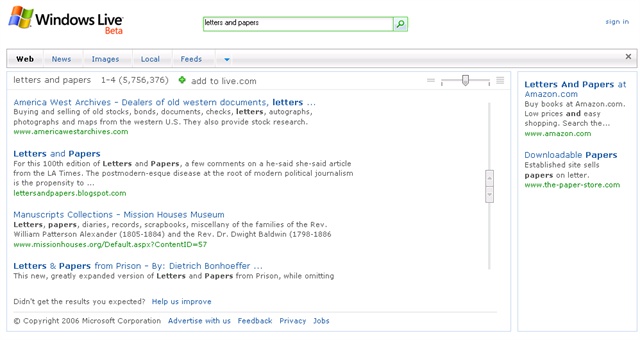
Anyhow, Microsoft's Google killer is now in Beta. It's called Windows Live, but it felt more like the living dead. It loaded slooooowly because it's a chromed-up web application. And the search results are... interesting. What follows are two web searches; one on Windows Live, one on Google. The search I used was ::letters and papers:: (colons not in the original, no quote marks).


Notice that Microsoft's search puts this blog at number 2, while Google's search puts the book Letters and Papers from Prison first. In fact, this blog hasn't been operating for a year, at least not yet, so I couldn't find myself on the first four or five pages of Google results, which means no one would find this blog with that search. Suspicious... has Microsoft just won another customer?

Ummm. No. I wouldn't use Windows Live for the kind of searching I do: quick, to the point, I needs me my information now. The web page loads too slowly for me to consider it; it does remind me of something else, though. When you sign up for GMail or a GAccount, you get a personal home page with a Google search box and news, weather, highlights and such that you can customize to your heart's content. Google was smart not to make this the de facto gateway to Google Search. I wonder if Windows Live is the de facto gateway to search for Windows Vista.

I also wonder what kind of ranking algorithm Microsoft uses, to put such a new site so near the top of the charts. I smell a rat. Next year, will all the search results go to cleverly tweaked Viagra blogs? Enquiring minds want to know.

If Microsoft wants to beat Google at their own game, this isn't the way to do it.

Tuesday, March 07, 2006

With the benefit of hindsight

Sarah and I have been reorganizing our house to give me a better office area to work in. We are trying to eliminate all my excuses for not being able to work well on my classes and job. I sit at the computer and feel deranged and unproductive for a long time, then go back to family stuff. It hasn't mattered whether I occupy the RA lab or work at home. So we cleaned out a lot of crap and got rid of my cluttered, cramped desk, in exchange for a beautiful dinner table we had in storage. I think it's made a big difference already.

In the midst of cleaning, I finally resolved to organize my personal papers. It's not too hard. I bought a hundred page protectors and a couple of binders, got out a few mini legal pads, then started annotating my life.

It has become easier with the benefit of hindsight. Now I can throw away papers I can't figure out any more; basically I toss something if I can stare at it for a few minutes without coming up with an insightful annotation tying it into the larger picture. And if I can't remember why it was important, I just let it go. I've been reading names and identifying handwriting that I haven't thought of for ten years. I've gotten to read snapshots of myself that I can't recognize, and memories as vivid as the day I made them.

I've learned, slowly, that I was a real yutz when I was talking to girls in high school; jointly written notes I saved show me talking to Girl A about Girls B and C, then to Girl D about Girls A and E. Sometimes I think it was out of congenial familiarity that they put up with all this careless talk; I can see other times that it annoyed them. And I was completely wrapped up in myself then. Re-visioning myself so clearly has been a pretty wild thing, but honest this time around. It doesn't help that I might as well be a stranger to that other me, at times.

I thank God today that I never sent some of the letters I have reread, as fatuous and puerile and selfish as they are. And then there are a couple I wish I had sent. I avoided living with the consequences of the former by strangling the latter. It was a fearful way to live. I'm also reminded, as if I needed reminding, that I've been writing fragments of poems and stories for a long long time, and that it wouldn't be terrible for me to keep at it. Some of it is real crap, but some of it is still good, which is practically a miracle.

I wonder if this stuff can really acquire a backbone, or even a chronology. If I can't even remember what I was doing in 1997 and sort out the dates, it's not like anyone else can. I wonder if I can take my neatly compartmentalized lives and mush them together again. And I don't just mean emails on my computer, love letters and artifacts and poems and drawings in my papers, four diaries and a few other little books. These papers have certain local attractors, threads of relationships that fit into these old personal narratives I made up and followed faithfully for years. I wonder if all the work will go anywhere, if it will mean anything to anyone but me. After all, I'm going to die, sooner or later, and my memories will wash away in the tide.

The first fifty sheets felt like a well dug into my heart, though, so I guess I'm in for another fifty.

Monday, February 27, 2006

Svarnik and Byll in Utah

Svarnik and Byll are anti-tobacco nerds who star in a series of television PSAs in Utah. They are dressed as medieval knights, and tell people not to smoke. The ads kind of suck in a school assembly way, but are funny in a Napoleon Dynamite way. (If anyone can find these in video or transcript, please tell me; I've Googled around without any love, and they're not on Ad Critic.)

I was just watching one where Svarnik and Byll are disparaging the series of PSAs that preceded them, involving a lab rat who became addicted to nicotine talking to people on a park bench. Most of the people don't want to talk to the rat. Example: "I wish smoking was easy to quit, like you could just eat a piece of banana bread. (Beat) Cause I likes banana bread."

This is my abbreviated approxa-transcript:

Svarnik and Byll are sparring near a park.

BYLL: Man, can you believe they tried to get people to stop smoking with a bunny?

SVARNIK: I think it was a rat.

BYLL: Bunny, rat, whatever. Why didn't they just say that smoking is really bad for you?

SVARNIK: Yeah, they could just say that. And that it's a sin.

BYLL: Yeah, it's a sin. (looks at girls smoking in park) Sinners!


Needless to say, in a state dominated by Mormon culture and politics, this is pretty crass. For that reason, funny.

But it's also an unintentionally revealing portrait of the way Mormons can stereotype non-Mormons as beer-swilling, tobacco-smoking, promiscuous divorcee anarchists. If you watch The Singles Ward, for instance, the non-Mormons in the film are portrayed as such, exclusively. The non-Mormon roommate has a mohawk (rainbow? I forget) and bungees his New Beetle off the edge of a cliff. When Main's wife leaves him, she immediately starts smoking and drinking. I would be inclined to say this is self-parody, but the climax of the movie depends on playing it straight. Either way, there is a grain of truth to it.

One time this happened to me was in Chinese class. I don't fault the guy who did it, because it was part of his culture. I should add too that he was one of my best friends in the class, and I would enjoy his company still, if I had the pleasure. One day he found out I wasn't a Mormon, and said, in effect, Well, I'd never have known, Dan... you're clean-cut and all. "'Hmmm. You don't look like an anarchist', he squinted and rubbed his chin" was the unspoken, unacted subtext.

He never found out that only Protestantism keeps me from completely going psycho on all you guys all the time.

Saturday, February 25, 2006

For the communicative

Here's my email:

Wednesday, February 22, 2006

All of it

In On Writing, Stephen King recounts an attitude he had when he was an alcoholic. At restaurants he would notice another diner with a half-drunk glass of wine, and be seized by the desire to march over and ask why they weren't finishing it. Alcoholics don't measure how much they're drinking. They drink all of it.

This weekend, I noticed that I have the same propensity to eat all of it, especially when "it" is meat. I was informed in some health class or other that meat is worth a hundred times its weight in grains necessary to produce it; I feel bad letting it all go to waste.

Or do I? I decided that I'm some kind of a foodaholic if I can't stop myself from cleaning my plate, eating all of it. Not wasting food is a red herring. I can just take less to begin with if that's the real issue. So I see myself as rationalizing away my addictive behavior.

I also noticed that when it comes to political blogs, in the last month or more, I've been getting really bad about reading all of it. It's cut into my work and family time, and the benefits I gain don't match the time I'm losing.

I think I get obsessive at times, and I need to learn to let things go. I need to be happier with what I have.

There's another one: remembering all of it. I realized this weekend as my parents were telling stories about their families and childhood that I have a lot of stories no one else knows, stories that are intensely personal and even unique. I have boxes of things I've saved, ways I saw myself. I feel like I should annotate them or something, like they're a window into my world. Save my remembrances. Put them in secret scrapbooks. Enjoy my history.

I don't know whether to be frightened that what I've done will be forgotten, or just to let it all go. In a way, I feel at loose ends with myself when I've forgotten my life, like I don't exist, or like the footprints I've made in the world are slowly washing away in the tides of time.

Monday, February 20, 2006

On the plus side

We've been having a wonderful time with my parents. They are visiting and enjoying our son.

Mom read an entire book while we were here. It is the alternative history of the Wicked Witch of the West, Wicked.

We watched the first Pink Panther movie. How did I forget that it sucks? But it does. It wasn't nearly as funny as I remember. Oh well, just have to go buy the other ones (except for the abominable Trail of the Pink Panther clip show).

We've been playing Settlers of Catan. For some reason I seem to keep getting boxed in, no matter what I do. I think I'm not used to playing in fours.

Dad has made some fabulous food: lemon ginger scones, clam chowder served with good champagne (or is that good champagne served with clam chowder and strawberries?), omelettes, pancakes, steaks tonight. We also bought Thai food at this new restaurant, Kamin Thai. Not even in Google Earth yet. They served our pineapple fried rice in a hollowed-out pineapple half. You could scrape fresh pineapple into your serving.

Dad also took Sarah and I to the liquor store and educated us about wine. He recognized makers he'd visited when he lived in Spain. Sometimes I forget what incredible sights my Mom and Dad have seen in their lives.

For those watching for news on the NSA spying story, I recommend this meta-post by Glenn Greenwald, who has carefully measured and found wanting the various Administration legal apologia for the commission of felonies in order to spy on Americans. There are various links in that post to the more detailed arguments. It's hard to beat Glenn Greenwald in general for information on this quite important scandal.

Thursday, February 16, 2006

Two quotes

"... as Heraclitus says, an ass would prefer chaff to gold..." -- Aristotle

"Twenty dollars? Awww, I wanted a peanut." -- Homer

Wednesday, February 15, 2006

A little late, but

If I speak in the tongues of men and of angels, but have not love, I am only a resounding gong or a clanging cymbal. If I have the gift of prophecy and can fathom all mysteries and all knowledge, and if I have a faith that can move mountains, but have not love, I am nothing. If I give all I possess to the poor and surrender my body to the flames, but have not love, I gain nothing.

Love is patient, love is kind. Love does not envy, love does not boast, love is not proud. Love is not rude, love is not self-seeking, love is not easily angered, love keeps no record of wrongs. Love does not delight in evil but rejoices with the truth. Love always protects, always trusts, always hopes, always perseveres.

Love never fails. But where there are prophecies, they will cease; where there are tongues, they will be stilled; where there is knowledge, it will pass away. For we know in part and we prophesy in part, but when perfection comes, the imperfect disappears. When I was a child, I talked like a child, I thought like a child, I reasoned like a child. When I became a man, I put childish ways behind me. Now we see but a poor reflection as in a mirror; then we shall see face to face. Now I know in part; then I shall know fully, even as I am fully known.

And now these three remain: faith, hope and love. But the greatest of these is love.

Tuesday, February 14, 2006

Republicans set to kill NSA spying investigation

[Cross-posted at Daily Kos. Background: Last week, Republicans claimed they were interested in a broad investigation of the Bush Administration's domestic wiretap program. After heavy political pressure from the White House, including meetings with Vice President Dick Cheney, who recently shot a man in the face, the same Republicans are pooh-poohing a serious investigation, claiming it would be "punitive". Interesting that the same executive that they are supposed to be investigating can persuade them not to investigate. Read more at the link in the first paragraph.]

From the article:

As for Rockefeller's bid, Hagel said: "If some kind of inquiry would be beneficial to getting a resolution to this issue, then sure, we should look at it. But if the inquiry is just some kind of a punitive inquiry that really is not focused on finding a way out of this, then I'm not so sure that I would support that."


The Republicans want to have it both ways: both a fair, honest inquiry to follow the truth to its resolution, and a non-punitive inquiry. What a load of crap. The two options are mutually exclusive. You can't follow the truth up to a point, only as long as it doesn't punish the President. You might as well prosecute the Mafia only as long as it doesn't lead to any convictions.

A punitive inquiry and a non-punitive inquiry are two sides of the same coin. One is biased to impeach the President and the other is biased to exonerate the President. The Republicans want the latter.

I want none of the above. I want subpoena power and fair judges. I want a special counsel independent of the Congress and the executive. I want the truth about the President's surveillance, even if the truth is far more innocent or far more sinister than we have been led to believe. I want transparency. I want oversight. I want checks and balances. I want a law-abiding president.

If the full Congress votes to soft-pedal its oversight of the NSA spying program, if the Republicans decide to shut down the investigation, Harry Reid should shut down the government. He was going to do it for the sake of the filibuster, remember; that was going to be the Democrat response to the nuclear option. He shut down the Senate for a day to protest the lackluster Phase II investigation. He should shut it down for nine months to protest the abuse of power by the executive.

What is at stake here is not just the power of a minority in the Senate to prevent laws from passing and judges from being confirmed. What is at stake here is even more important than learning whether or how politicians misled a country into war. What is at stake is the power of the full Congress to make laws at all. What is at stake is the unbounded, secret power of a wartime executive applied against the citizens he governs.

Twenty years ago, Senator Frank Church warned of the dangers of letting the NSA get involved in domestic intelligence gathering. He said that the "potential to violate the privacy of Americans is unmatched by any other intelligence agency." If the resources of the NSA were ever used domestically, "no American would have any privacy left.... There would be no place to hide. .. We must see to it that this agency and all agencies that possess this technology operate within the law and under proper supervision, so that we never cross over that abyss. That is an abyss from which there is no return."

-- Bruce Schneier, on Project Shamrock and the spying scandal

Wednesday, February 08, 2006

Scientific notes

Some quick thoughts about science, inspired by this, via this.

A principle of reinforcement learning (for computers) is that an agent acts in an environment, and remembers in order to predict the future state of the environment, then (or at the same time) maximizes its total reward over its lifespan in the environment. Thus, learning systems solve problems embodied by the structure of their rewards. It seems to me that what science claims to do is almost the same thing: predict the future state of the (physical) environment given a certain action in a present state (some would prefer to omit the idea that actions exist). But science omits the other part of reinforcement learning: the maximization of reward. In science, there are no fixed rewards. Thus, there are no fixed problems.

How do we know that induction (essentially, science) leads somehow to justified true belief (knowledge)? Why should it be privileged over intuition or mysticism or revelation as a knowledge-seeking tool? As I understand Wittgenstein to say, there is nowhere to stand to judge such questions.

Monday, February 06, 2006

A few notes

I made the best spinach artichoke dip I've ever had and the Seahawks still lost the Super Bowl.

Sarah got a relatively new G4 iMac from her brother, who got a Mac from his dad, who bought a new Mac. I didn't get a Mac, so I ordered a microphone to record music on the computer. I'll learn GarageBand and make plunky loops with my mandolin.

I'm past the middle of Jonathan Strange & Mr Norrell, a Napoleonic-era alternate history of English magic. The language and point of view are just about perfect. And it's really funny. And it's addictive! I have no clue how it's going to end.

Today I kept half an ear on the start of something very important: the first hearing on the President's secret warrantless domestic wiretap program. Attorney General Gonzales was in the Judiciary Committee arguing that the program is legal. The Bush Administration felt free not to follow the controlling law, FISA, because it was authorized broadly to combat al-Qaeda, or failing that, the President's commander-in-chief powers allow him to violate duly enacted legislation.

To my great relief, most of the Senators on the committee, including all the Democrats and even some Republicans (though not all of them), saw Bush's arguments as ridiculous and untenable. As especially Senator Leahy drove home, this one program, whose existence was leaked to the New York Times, is probably only the tip of an iceberg of broad expansions in domestic surveillance. For several years, the Bush Administration wiretapped people it had no business wiretapping, and it didn't tell anyone, and no one found out; did they abuse the power once they figured they wouldn't be caught?

A deeper issue: the Administration's second argument seems to imply that the President can break any law as long as he determines that it is necessary to do so to combat al-Qaeda. This means that de facto anything is legal as long as no one finds out about it; if Bush keeps it on the down low, he can order his branch of government to do whatever he wants. We shouldn't just be worried about how the President has actually used this power (which is bad enough); we need to be worried about a President who feels like he has a free hand to ignore the law. Access to that kind of power is anti-American. Broad executive power is taking us down an autocratic road, and we should all be disturbed by that.