Tuesday, March 14, 2006

Just a quick note

We don't get Sci-Fi Channel so I am a bit behind, but my wife and I just watched the opening miniseries of Battlestar Galactica (about four episodes).

It was frigging awesome.

We might have to buy whole seasons on DVD just to watch it.

Friday, March 10, 2006

Svarnik and Byll hit the Internets!

Well! Here is an exciting follow-up to Svarnik and Byll in Utah, my short send-up of Utah's smoking-fighting dynamic duo. After I posted, I was contacted by the advertising firm responsible for the PSAs, Crowell Advertising.

In short, as an appreciative fan of Byll and Svarnik, I have been offered permission to host and share the 5 television spots. You too can host and share them, on the same two conditions I was given: 1) Credit the firm, Crowell Advertising, wherever these videos are posted; 2) If you do decide to post them, drop a note to Chip Haskell from the firm. He is interested to watch the grassroots spread of the Svarnik and Byll phenomenon. You can also see a couple of the spots on the Crowell Advertising website (if you want to navigate through the Flash to "our work").

I'll host them on my USU website. I don't know that I have any bandwidth cap there, but I guess we'll find out. Internets, I give you... Svarnik and Byll!


The one I posted about last time was "TV Idea". I think you'll agree that it's quite funny, especially for Utah.

Big thanks to Crowell Advertising and Chip Haskell for making these available.

P.S. These are also available in Windows Media format; you might just email Chip Haskell directly, or write me.

Wednesday, March 08, 2006

A tale of two searches

Google has been notorious for releasing products in Beta. Beta is a software development/marketing term that means a core software product is complete enough to be released to a select group of reviewers and testers. These Beta testers monkey around with the software to achieve many ends: finding errors, ease-of-use and user interface, stress testing, buzz, and so on. You do this just before you release a product to market, on the philosophy that no battle plan survives first contact with the enemy, who in this case is the software consumer. They don't call it killer app for nothing.

Google News was in Beta for more than three years. I explained to a friend my ideas about how Google is using Beta: lowered expectations (because no Beta is supposed to be perfect), continuous development and feature rollout (more possible with web-served applications like Google Search than desktop applications like Microsoft Word), continuous hype and buzz (Google Widget 221 acquires Sprocket A! stories appear basically every day on Slashdot). Some recent Betas are Google Transit, Google Page Creator, Google Reader, and Google Video.

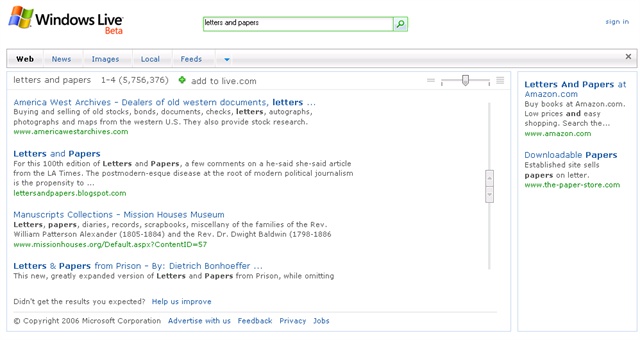
Anyhow, Microsoft's Google killer is now in Beta. It's called Windows Live, but it felt more like the living dead. It loaded slooooowly because it's a chromed-up web application. And the search results are... interesting. What follows are two web searches; one on Windows Live, one on Google. The search I used was ::letters and papers:: (colons not in the original, no quote marks).


Notice that Microsoft's search puts this blog at number 2, while Google's search puts the book Letters and Papers from Prison first. In fact, this blog hasn't been operating for a year, at least not yet, so I couldn't find myself on the first four or five pages of Google results, which means no one would find this blog with that search. Suspicious... has Microsoft just won another customer?

Ummm. No. I wouldn't use Windows Live for the kind of searching I do: quick, to the point, I needs me my information now. The web page loads too slowly for me to consider it; it does remind me of something else, though. When you sign up for GMail or a GAccount, you get a personal home page with a Google search box and news, weather, highlights and such that you can customize to your heart's content. Google was smart not to make this the de facto gateway to Google Search. I wonder if Windows Live is the de facto gateway to search for Windows Vista.

I also wonder what kind of ranking algorithm Microsoft uses, to put such a new site so near the top of the charts. I smell a rat. Next year, will all the search results go to cleverly tweaked Viagra blogs? Enquiring minds want to know.

If Microsoft wants to beat Google at their own game, this isn't the way to do it.

Tuesday, March 07, 2006

With the benefit of hindsight

Sarah and I have been reorganizing our house to give me a better office area to work in. We are trying to eliminate all my excuses for not being able to work well on my classes and job. I sit at the computer and feel deranged and unproductive for a long time, then go back to family stuff. It hasn't mattered whether I occupy the RA lab or work at home. So we cleaned out a lot of crap and got rid of my cluttered, cramped desk, in exchange for a beautiful dinner table we had in storage. I think it's made a big difference already.

In the midst of cleaning, I finally resolved to organize my personal papers. It's not too hard. I bought a hundred page protectors and a couple of binders, got out a few mini legal pads, then started annotating my life.

It has become easier with the benefit of hindsight. Now I can throw away papers I can't figure out any more; basically I toss something if I can stare at it for a few minutes without coming up with an insightful annotation tying it into the larger picture. And if I can't remember why it was important, I just let it go. I've been reading names and identifying handwriting that I haven't thought of for ten years. I've gotten to read snapshots of myself that I can't recognize, and memories as vivid as the day I made them.

I've learned, slowly, that I was a real yutz when I was talking to girls in high school; jointly written notes I saved show me talking to Girl A about Girls B and C, then to Girl D about Girls A and E. Sometimes I think it was out of congenial familiarity that they put up with all this careless talk; I can see other times that it annoyed them. And I was completely wrapped up in myself then. Re-visioning myself so clearly has been a pretty wild thing, but honest this time around. It doesn't help that I might as well be a stranger to that other me, at times.

I thank God today that I never sent some of the letters I have reread, as fatuous and puerile and selfish as they are. And then there are a couple I wish I had sent. I avoided living with the consequences of the former by strangling the latter. It was a fearful way to live. I'm also reminded, as if I needed reminding, that I've been writing fragments of poems and stories for a long long time, and that it wouldn't be terrible for me to keep at it. Some of it is real crap, but some of it is still good, which is practically a miracle.

I wonder if this stuff can really acquire a backbone, or even a chronology. If I can't even remember what I was doing in 1997 and sort out the dates, it's not like anyone else can. I wonder if I can take my neatly compartmentalized lives and mush them together again. And I don't just mean emails on my computer, love letters and artifacts and poems and drawings in my papers, four diaries and a few other little books. These papers have certain local attractors, threads of relationships that fit into these old personal narratives I made up and followed faithfully for years. I wonder if all the work will go anywhere, if it will mean anything to anyone but me. After all, I'm going to die, sooner or later, and my memories will wash away in the tide.

The first fifty sheets felt like a well dug into my heart, though, so I guess I'm in for another fifty.

Monday, February 27, 2006

Svarnik and Byll in Utah

Svarnik and Byll are anti-tobacco nerds who star in a series of television PSAs in Utah. They are dressed as medieval knights, and tell people not to smoke. The ads kind of suck in a school assembly way, but are funny in a Napoleon Dynamite way. (If anyone can find these in video or transcript, please tell me; I've Googled around without any love, and they're not on Ad Critic.)

I was just watching one where Svarnik and Byll are disparaging the series of PSAs that preceded them, involving a lab rat who became addicted to nicotine talking to people on a park bench. Most of the people don't want to talk to the rat. Example: "I wish smoking was easy to quit, like you could just eat a piece of banana bread. (Beat) Cause I likes banana bread."

This is my abbreviated approxa-transcript:

Svarnik and Byll are sparring near a park.

BYLL: Man, can you believe they tried to get people to stop smoking with a bunny?

SVARNIK: I think it was a rat.

BYLL: Bunny, rat, whatever. Why didn't they just say that smoking is really bad for you?

SVARNIK: Yeah, they could just say that. And that it's a sin.

BYLL: Yeah, it's a sin. (looks at girls smoking in park) Sinners!


Needless to say, in a state dominated by Mormon culture and politics, this is pretty crass. For that reason, funny.

But it's also an unintentionally revealing portrait of the way Mormons can stereotype non-Mormons as beer-swilling, tobacco-smoking, promiscuous divorcee anarchists. If you watch The Singles Ward, for instance, the non-Mormons in the film are portrayed as such, exclusively. The non-Mormon roommate has a mohawk (rainbow? I forget) and bungees his New Beetle off the edge of a cliff. When Main's wife leaves him, she immediately starts smoking and drinking. I would be inclined to say this is self-parody, but the climax of the movie depends on playing it straight. Either way, there is a grain of truth to it.

One time this happened to me was in Chinese class. I don't fault the guy who did it, because it was part of his culture. I should add too that he was one of my best friends in the class, and I would enjoy his company still, if I had the pleasure. One day he found out I wasn't a Mormon, and said, in effect, Well, I'd never have known, Dan... you're clean-cut and all. "'Hmmm. You don't look like an anarchist', he squinted and rubbed his chin" was the unspoken, unacted subtext.

He never found out that only Protestantism keeps me from completely going psycho on all you guys all the time.

Saturday, February 25, 2006

For the communicative

Here's my email:

Wednesday, February 22, 2006

All of it

In On Writing, Stephen King recounts an attitude he had when he was an alcoholic. At restaurants he would notice another diner with a half-drunk glass of wine, and be seized by the desire to march over and ask why they weren't finishing it. Alcoholics don't measure how much they're drinking. They drink all of it.

This weekend, I noticed that I have the same propensity to eat all of it, especially when "it" is meat. I was informed in some health class or other that meat is worth a hundred times its weight in grains necessary to produce it; I feel bad letting it all go to waste.

Or do I? I decided that I'm some kind of a foodaholic if I can't stop myself from cleaning my plate, eating all of it. Not wasting food is a red herring. I can just take less to begin with if that's the real issue. So I see myself as rationalizing away my addictive behavior.

I also noticed that when it comes to political blogs, in the last month or more, I've been getting really bad about reading all of it. It's cut into my work and family time, and the benefits I gain don't match the time I'm losing.

I think I get obsessive at times, and I need to learn to let things go. I need to be happier with what I have.

There's another one: remembering all of it. I realized this weekend as my parents were telling stories about their families and childhood that I have a lot of stories no one else knows, stories that are intensely personal and even unique. I have boxes of things I've saved, ways I saw myself. I feel like I should annotate them or something, like they're a window into my world. Save my remembrances. Put them in secret scrapbooks. Enjoy my history.

I don't know whether to be frightened that what I've done will be forgotten, or just to let it all go. In a way, I feel at loose ends with myself when I've forgotten my life, like I don't exist, or like the footprints I've made in the world are slowly washing away in the tides of time.

Monday, February 20, 2006

On the plus side

We've been having a wonderful time with my parents. They are visiting and enjoying our son.

Mom read an entire book while we were here. It is the alternative history of the Wicked Witch of the West, Wicked.

We watched the first Pink Panther movie. How did I forget that it sucks? But it does. It wasn't nearly as funny as I remember. Oh well, just have to go buy the other ones (except for the abominable Trail of the Pink Panther clip show).

We've been playing Settlers of Catan. For some reason I seem to keep getting boxed in, no matter what I do. I think I'm not used to playing in fours.

Dad has made some fabulous food: lemon ginger scones, clam chowder served with good champagne (or is that good champagne served with clam chowder and strawberries?), omelettes, pancakes, steaks tonight. We also bought Thai food at this new restaurant, Kamin Thai. Not even in Google Earth yet. They served our pineapple fried rice in a hollowed-out pineapple half. You could scrape fresh pineapple into your serving.

Dad also took Sarah and I to the liquor store and educated us about wine. He recognized makers he'd visited when he lived in Spain. Sometimes I forget what incredible sights my Mom and Dad have seen in their lives.

For those watching for news on the NSA spying story, I recommend this meta-post by Glenn Greenwald, who has carefully measured and found wanting the various Administration legal apologia for the commission of felonies in order to spy on Americans. There are various links in that post to the more detailed arguments. It's hard to beat Glenn Greenwald in general for information on this quite important scandal.

Thursday, February 16, 2006

Two quotes

"... as Heraclitus says, an ass would prefer chaff to gold..." -- Aristotle

"Twenty dollars? Awww, I wanted a peanut." -- Homer

Wednesday, February 15, 2006

A little late, but

If I speak in the tongues of men and of angels, but have not love, I am only a resounding gong or a clanging cymbal. If I have the gift of prophecy and can fathom all mysteries and all knowledge, and if I have a faith that can move mountains, but have not love, I am nothing. If I give all I possess to the poor and surrender my body to the flames, but have not love, I gain nothing.

Love is patient, love is kind. Love does not envy, love does not boast, love is not proud. Love is not rude, love is not self-seeking, love is not easily angered, love keeps no record of wrongs. Love does not delight in evil but rejoices with the truth. Love always protects, always trusts, always hopes, always perseveres.

Love never fails. But where there are prophecies, they will cease; where there are tongues, they will be stilled; where there is knowledge, it will pass away. For we know in part and we prophesy in part, but when perfection comes, the imperfect disappears. When I was a child, I talked like a child, I thought like a child, I reasoned like a child. When I became a man, I put childish ways behind me. Now we see but a poor reflection as in a mirror; then we shall see face to face. Now I know in part; then I shall know fully, even as I am fully known.

And now these three remain: faith, hope and love. But the greatest of these is love.

Tuesday, February 14, 2006

Republicans set to kill NSA spying investigation

[Cross-posted at Daily Kos. Background: Last week, Republicans claimed they were interested in a broad investigation of the Bush Administration's domestic wiretap program. After heavy political pressure from the White House, including meetings with Vice President Dick Cheney, who recently shot a man in the face, the same Republicans are pooh-poohing a serious investigation, claiming it would be "punitive". Interesting that the same executive that they are supposed to be investigating can persuade them not to investigate. Read more at the link in the first paragraph.]

From the article:

As for Rockefeller's bid, Hagel said: "If some kind of inquiry would be beneficial to getting a resolution to this issue, then sure, we should look at it. But if the inquiry is just some kind of a punitive inquiry that really is not focused on finding a way out of this, then I'm not so sure that I would support that."


The Republicans want to have it both ways: both a fair, honest inquiry to follow the truth to its resolution, and a non-punitive inquiry. What a load of crap. The two options are mutually exclusive. You can't follow the truth up to a point, only as long as it doesn't punish the President. You might as well prosecute the Mafia only as long as it doesn't lead to any convictions.

A punitive inquiry and a non-punitive inquiry are two sides of the same coin. One is biased to impeach the President and the other is biased to exonerate the President. The Republicans want the latter.

I want none of the above. I want subpoena power and fair judges. I want a special counsel independent of the Congress and the executive. I want the truth about the President's surveillance, even if the truth is far more innocent or far more sinister than we have been led to believe. I want transparency. I want oversight. I want checks and balances. I want a law-abiding president.

If the full Congress votes to soft-pedal its oversight of the NSA spying program, if the Republicans decide to shut down the investigation, Harry Reid should shut down the government. He was going to do it for the sake of the filibuster, remember; that was going to be the Democrat response to the nuclear option. He shut down the Senate for a day to protest the lackluster Phase II investigation. He should shut it down for nine months to protest the abuse of power by the executive.

What is at stake here is not just the power of a minority in the Senate to prevent laws from passing and judges from being confirmed. What is at stake here is even more important than learning whether or how politicians misled a country into war. What is at stake is the power of the full Congress to make laws at all. What is at stake is the unbounded, secret power of a wartime executive applied against the citizens he governs.

Twenty years ago, Senator Frank Church warned of the dangers of letting the NSA get involved in domestic intelligence gathering. He said that the "potential to violate the privacy of Americans is unmatched by any other intelligence agency." If the resources of the NSA were ever used domestically, "no American would have any privacy left.... There would be no place to hide. .. We must see to it that this agency and all agencies that possess this technology operate within the law and under proper supervision, so that we never cross over that abyss. That is an abyss from which there is no return."

-- Bruce Schneier, on Project Shamrock and the spying scandal

Wednesday, February 08, 2006

Scientific notes

Some quick thoughts about science, inspired by this, via this.

A principle of reinforcement learning (for computers) is that an agent acts in an environment, and remembers in order to predict the future state of the environment, then (or at the same time) maximizes its total reward over its lifespan in the environment. Thus, learning systems solve problems embodied by the structure of their rewards. It seems to me that what science claims to do is almost the same thing: predict the future state of the (physical) environment given a certain action in a present state (some would prefer to omit the idea that actions exist). But science omits the other part of reinforcement learning: the maximization of reward. In science, there are no fixed rewards. Thus, there are no fixed problems.

How do we know that induction (essentially, science) leads somehow to justified true belief (knowledge)? Why should it be privileged over intuition or mysticism or revelation as a knowledge-seeking tool? As I understand Wittgenstein to say, there is nowhere to stand to judge such questions.

Monday, February 06, 2006

A few notes

I made the best spinach artichoke dip I've ever had and the Seahawks still lost the Super Bowl.

Sarah got a relatively new G4 iMac from her brother, who got a Mac from his dad, who bought a new Mac. I didn't get a Mac, so I ordered a microphone to record music on the computer. I'll learn GarageBand and make plunky loops with my mandolin.

I'm past the middle of Jonathan Strange & Mr Norrell, a Napoleonic-era alternate history of English magic. The language and point of view are just about perfect. And it's really funny. And it's addictive! I have no clue how it's going to end.

Today I kept half an ear on the start of something very important: the first hearing on the President's secret warrantless domestic wiretap program. Attorney General Gonzales was in the Judiciary Committee arguing that the program is legal. The Bush Administration felt free not to follow the controlling law, FISA, because it was authorized broadly to combat al-Qaeda, or failing that, the President's commander-in-chief powers allow him to violate duly enacted legislation.

To my great relief, most of the Senators on the committee, including all the Democrats and even some Republicans (though not all of them), saw Bush's arguments as ridiculous and untenable. As especially Senator Leahy drove home, this one program, whose existence was leaked to the New York Times, is probably only the tip of an iceberg of broad expansions in domestic surveillance. For several years, the Bush Administration wiretapped people it had no business wiretapping, and it didn't tell anyone, and no one found out; did they abuse the power once they figured they wouldn't be caught?

A deeper issue: the Administration's second argument seems to imply that the President can break any law as long as he determines that it is necessary to do so to combat al-Qaeda. This means that de facto anything is legal as long as no one finds out about it; if Bush keeps it on the down low, he can order his branch of government to do whatever he wants. We shouldn't just be worried about how the President has actually used this power (which is bad enough); we need to be worried about a President who feels like he has a free hand to ignore the law. Access to that kind of power is anti-American. Broad executive power is taking us down an autocratic road, and we should all be disturbed by that.

Monday, January 30, 2006

Wars

It occurred to me while reading this post by Digby that we call the fake war, the one with no attacks on American soil since after it was declared, the one with no battlefields and no uniforms and no Geneva Conventions, "war on terror", but we call the real war, the one where American soldiers are dying every day, "war in Iraq".

The war on terror has enemies but no location, the war in Iraq has location but no enemies. The location of the war on terror is everywhere and nowhere. The enemies in the war in Iraq are everyone and no one.

Because the location of the war on terror is everywhere, the president's war powers are now domestic. The terrorists have already won. Every step the president takes to protect our security at the expense of our essential freedoms is a victory for the terrorists. They didn't just want to kill people; they wanted to destroy our way of life. Sadly, the war on terror is nowhere; we don't have victories in the war on terror, just missile strikes in nameless villages on nameless terrorists, killing nameless people. Five more appear for every one that dies. There is no place to win the war on terror. It will never end.

Because the enemies in Iraq are everyone, trust is impossible, and victory is impossible. Anyone can blow you up. Almost everyone has a reason to. Because the enemies in Iraq are no one, defeating them is impossible, and victory is impossible.

Lest we forget, Bush has repeatedly conflated the war on terror and the war in Iraq. He wants to shore up the deficiencies in each war by giving the Iraq War a face and the war on terror a country. Never mind that this construction has been ridiculous since the first days after 9/11, when Bush was convinced that Saddam was behind the attack.

It's become increasingly clear in recent weeks that the war on terror's face and location are American, at least to the American President. What is he doing? What is he thinking?

Sunday, January 29, 2006

A bad week for staying on task

Well, that was the most godawful seven days of studying I have put in at Utah State, bar none. Sarah has been trying to keep me keeping it together. But it has been truly terrible. I don't know why exactly. I think Sarah and I are both trying to adjust to me being home all day and available for X and Y and Z.

I have an uninhabited office on campus that is basically mine to run around with, so I might start working up there some days.

I am also thinking of going back to exercise. Most of my old friends would put me to shame in personal health, I'm afraid. So this has been a bit of a phase. A four-plus year weight gain. I think I said recently that the physical affects the spiritual and the mental and emotional; maybe my lack of having to walk several blocks to my car every day has been wearing on me for the last few weeks. It was bitterly cold all the way to my parking spot, but I reaped the benefits last semester in inches and pounds.

As a Christian, I'm not obsessed with body image. I have more important things to be obsessed about, like social image and looking competent for my professors. I get sick of this and just want to be myself, but I don't know what the professional distance is with my mentors, my colleagues.

I had very strange problems with social image in Undergraduate v1.0, where I would miss a class or an assignment, and then I would cut class until the drop date, then drop. Or just not drop and fail. Or, in one of my many classroom horror experiences, fail to drop, and have to go take the final, and fail the final. As near as I can put it, I was extremely anxious about looking like a bad student, or like a failure. I had my priorities out of whack too, so I would miss one class because I stayed up too late playing Tekken 3 or whatnot, and then for the next class all my sensors would overload. If I'd been more honest about the whole thing, I would've run around the dormitory screaming and waving my arms around. That's how I felt about it every time: naked fear. My jaw is clenching right now just remembering it.

This lasted for the better part of four years. I didn't get over it until I started up at USU, after several months of the real world to knock some sense into me (including a stint as a production worker at a Camelbak-type waterbag factory).

But it still comes back sometimes, especially when I'm talking to professors. I stutter and have it all worked out in my mind ahead of time, like notes. I'm a nice guy, but I can't loosen up. I don't even know how to try; I have fun and I enjoy most everything that I'm learning. Maybe I desperately need to go to a department picnic or something.

I feel a bit better for having said all that.

Meanwhile, I'll be taking Tolkien on tape to the exercise machines, for a long overdue healthening. Like I said, I'm not obsessed with body image. But there are reasons to consider healthening to be the Christian thing to do. Jesus said once that "out of the overflow of the heart the mouth speaks." I have been mulling this over for a while and I'm starting to think it's a pretty deep statement. But anyway, by analogy, out of the overflow of my self-concept, or my character, my body is shaped. And right now my self-concept looks pretty flabby and lazy, and forgotten. Also, and perhaps more to the point, "You are not your own; you were bought at a price. Therefore honor God with your body." This is an interesting little proof, and I will be exploring it in detail at the gym.

Good healthening to all of you too.

Wednesday, January 25, 2006

One by Endo

I finished one of the best books I've ever read. Again. It's Scandal by Shusaku Endo. I've commented on Endo's work before; he's one of the best authors you will ever read, the Japanese Graham Greene. Book space is dear at our house, but I have eight of his books on my shelf.

Here's Scandal on Amazon. I wrote a spoiler-free review there, but others gave away more than I would have. So here it is:

Scandal is the story of an acclaimed Japanese Christian novelist in old age named Suguro. At an awards ceremony honoring his distinguished career, Suguro hears disquieting rumors that he has been seen carousing in the red-light district. He enters the district to investigate the rumors and safeguard his reputation, but is unprepared for what, and who, he finds there.

Shusaku Endo uses this story as a kind of autobiography, accurate in depth of feeling, if not character and circumstance. He said in his A Life of Jesus that he thought of the Gospels as collectively forming a true portrait of Jesus, even where he saw them as fuzzy on the details. That is a good way to read Scandal, as a portrait of Endo.

Suguro struggles with old age, oncoming death, and the dissonance between his private self and his public reputation as an upstanding Christian. In many ways, Suguro is forced to confront himself; he learns that the foundations he has built his life upon are unsound, even his work, his marriage, and his religion. Endo's unflinching portrayal of himself in the figure of Suguro is thus poignant and, at times, tragic.

Scandal is about, among other things, a man going to a dangerous, uncertain place with his religion. Some religious people will not want to follow him there. On the other hand, this is not an exclusively Christian novel, and readers of any religion, or none, would have much to gain from it.

It is helpful, but not necessary, to have read some of Endo's other work to put Scandal in context. Silence and A Life of Jesus are classics. At least ten other works are in English translation.

Scandal is so rich and complex, and finally, so human, that it practically requires a second reading. But I am beginning to find that each time I read it, I demand another reading myself. I doubt that I will ever come to the end of it.

It's hard to explain further than that unless you've read the book, which I hereby suggest you all do.

Saturday, January 21, 2006

Work, Utah, religion, publicity

I wrote this post in a sort of meandering way, so expect the main topic to slide around a bit.

Three years ago plus about a month, Sarah and I got married in Maranatha Baptist Church here in Logan. About a week later, I started working for WestWords, a college textbook compositor. We designed typesetting and book layouts, then published them all the way from red-inked manuscript to the printer.

I was especially proud of working on The Feynman Lectures on Physics. This is sort of the Holy Grail of physics textbooks, by Richard Feynman, a very popular guy for a Nobel Prize winner. They hadn't been corrected for decades. We worked on the definitive edition. I designed the mathematics typesetting that we used to enter corrections.

I also worked as the customer service point person for our company's software, MathMonarch. It stretched me a lot to work out problems with customers, with no training in business writing and such. I tried to act like their advocate and see things from their point of view.

Anyway, yesterday was my last day. I felt very ambivalent about leaving this job, which completed my longest continuous stint at any one workplace. I got another job for roughly equal pay, to do research for one of my professors at USU. It was a good career move and it will give me good scientist experience.

But I'll miss all the people I made friends with. Since I went to part-time when I started school in June 2004, I've felt some disconnection from them.

To be honest, too, because I live here in Utah and 80-90% of my co-workers were LDS, I felt somewhat disconnected from the dominant thing in their lives. I didn't have much way to share what they saw.

I remember early in the job, one of the managers, not with the company now, came and talked to someone who'd started when I did, about all their personal connections in the valley. Around here, family is intimately connected to religion and I felt very isolated.

I'd been through a pretty bad set of months just before starting at WestWords where I worked in a bottle factory as a temp (bought by Nalgene when I left). I had gotten into arguments, and even one shouting match about religion, even at work. I didn't have any sense of what should be public and private. I was very gung ho about being in Utah and shining my lonely Protestant light, adrift on a raft of orthodoxy, floating above an endless ocean of darkness. It didn't take me long to see the inadequacy of this viewpoint.

So at WestWords, I turned the other direction. most of my discussions about religion began and ended with the fact that I wasn't Mormon. I found it hard to follow my co-workers into their religious territory, even couched in very broad terms. If any of them reads this, I would want them to understand that I didn't blame them for this and I had no hard feelings. They were fish swimming in their own water. I learned a lot by listening to them talk about what their religion meant to them.

Now that I'm working elsewhere, I get to decide how public or private religion should be with my professors. Sarah gave me a necklace with a cross on it for Christmas. I asked for it because I wanted, among other things, to have a sort of physical expression of my inward belief. Maybe there is some parallel here to the Sacraments. Or, like CS Lewis said in Screwtape or somewhere, there is something different about praying in your head and praying aloud on your knees, because humans are physical beings, and physical movement alters the mental, emotional, and spiritual.

But I wear it under my shirt because the cross is not socially acceptable in Utah. The long practice of the LDS people is to regard wearing the cross as somewhat morbid and concentrating on the suffering of Christ rather than the resurrection of Christ. If you Google "mormon cross" you will run across the explanations (from Mormons and non-Mormons alike). I'm not trying to make big waves because of something that's on my shirt, so it stays hidden, just for me.

[digression: Incidentally, there is an interesting thread at badchristian.com about making waves for Christ through the wearing of shirts, particularly shirts with quasi-Christian messages calculated to shock or offend. I wrote a comment there that probably makes more sense if you read the discussion it refers to.]

Still, by accident, I've had it out in front of both of my professors, and this is only the third week of the semester.

Starting Monday, I have one class-hour on Mondays, Wednesdays, and Fridays, a meeting for my research on Mondays, and a meeting for my independent-study class, meeting at, well, irregular intervals. Five hours are spoken for. The rest of my time is my own.

And so again, I'm ambivalent. It's a stunning opportunity to show what I'm made of, how responsibly I can manage my time, and what a career in research might feel like. But I don't have as much direction, nor a manager, nor insulation from bureaucracies, nor co-workers. I could get pretty stir-crazy in my cave. Time will tell, I guess.

Sunday, January 15, 2006

Threads

When I was a foolish, foolish young man going to college, I took a spice rack that had doors on hinges, with all the spices it contained and a few others nearby. My childhood home in Seattle has essentially two units, and this spice rack came from the unused downstairs kitchen. It had 21 spices, some that I'd never even heard of (like foenugreek; is that spelled right?).

One of the other bottles had a white label with permanent marker: "SAFRON". It was an ordinary sized spice jar.

It was also full.

I didn't understand the significance of this for quite a while. I felt vaguely guilty, but I thought it should smell good, so I put uncrushed threads of saffron in my microwave popcorn. At some point, the guilt got to be too much for me, and I stopped using it. Fortunately, most of the bottle was still left.

I told my dad about the popcorn and he thought I was incredibly crazy.

For those who don't know, saffron is the handpicked stigmata (female sex organ) of a Crocus Sativus Linneaus. Each flower has three. It takes 100,000 or so to make a pound. Here's a helpful article that is quite interesting; among other things, it pegs the price of saffron at $40 to $65 per ounce, more expensive than silver. Whole Foods, it says, was selling some at $8.99 per 0.04 ounce, which is more like $225 per ounce.

I finally saw saffron on sale at our local kitchen store. It is sold in spice jars with small cards that look like flypaper, with a thumbnail's worth of the spice trapped on the side. I have no clue now how much my stash is worth. I've noticed that time and gravity have ground down the spice near the bottom of the jar, but the vast majority are still whole.

Today I took out my jar of saffron. It has been snowing since the morning and I decided to make potato soup. I picked out a few threads, less than 10, and put them into a white 1/4 cup measuring cup so I wouldn't lose any. I dropped one on the floor and picked it right up. Then I used the back of a small spoon to grind the threads into powder. At the end, I held it up to my face, and they stirred like iron filings attracted by a magnet while I breathed through my nose. I couldn't believe that such a small thing could flavor about a gallon of potato soup, but I dumped them into the slow cooker anyway. The liquid turned yellow immediately.

A few hours later, the onions aren't done, but the broth is delicious.

Sometime, go to the store and buy some yellow rice in a packet, by Vigo or Mahatma or a similar brand. Look at the ingredients list; after all the spices, salts, and even chemical preservatives, the least, final ingredient is saffron.

Wednesday, January 11, 2006

Century mark

For this 100th edition of Letters and Papers, a few comments on a he-said she-said article from the LA Times.

The postmodern-esque disease at the root of modern political journalism is the propensity to act as sound-bite stenographers. You're not allowed to say who is lying, or who is wrong. You must give equal time to opposing partisans. If an issue reflects badly on one party, a similar pejorative issue must be found for the opposing party, no matter how dissimilar or inconsequential. No judgment, no reasoning. The main tool is the tape recorder.

Witness the article I linked, where the main story is "Bush says critics in Iraq war 'irresponsible'; critics disagree". It has 22 paragraphs, 18 of which are devoted to direct or indirect quotations. By the latter I mean things that could have been replaced with a quotation, like "Bush said the war's critics should stop questioning the motives that led him to launch the invasion of Iraq in March 2003." It doesn't get any shallower than this.

The journalists say their readers can judge for themselves who is lying and who is wrong. And that the story is all there if you read between the lines. To my mind, this is completely irresponsible. The first-drafters of history are selecting information and weaving narratives; maybe they congratulate themselves on their subtlety.

But they are the public's paid summarizers, and they aren't doing their jobs. You have to go to editorial and partisan and advocacy viewpoints just to get to truth-telling above reproach. It ticks me off that these news organizations are not willing to put their credibility on the line to tell the truth.

Anyway, I wouldn't be writing this if I hadn't noticed an odd juxtaposition that is like reading between the lines. It involves one of the four non-quotation paragraphs in the article, and an apparent non-sequitur.

[Bush] said that when soldiers in a battle zone heard politicians questioning their mission, "it hurts their morale."

In a new surge in violence, 120 Iraqis have been killed in suicide bombings in the last week in Karbala and Ramadi, and 29 were killed in an attack in Baghdad on Monday, Associated Press reported. Since the Dec. 15 elections, 498 Iraqis and 54 Americans have been killed.


Get it? The second paragraph follows the first because it responds to the first paragraph. After all, if politicians criticizing the President hurts your morale, just imagine what getting killed a lot does for it.

The rest of the article is about Bush-said and Democrats-said; but the important thing is Reality-said. And it was a doozy, right? That's how you read between the lines and find out the truth, on Paragraphs 17 and 18.

This completes the initiation into the Hermeneutic Order of Newspaper Reading, Guardians of the Public Mysteries, Keepers of the Purple Shaft. See you tomorrow, in between Paragraphs 15 and 20.

Tuesday, January 10, 2006

Language problems in Christianity

[Note: This was cross-posted as a comment on a post on badchristian.com about Christian politics.]

I read TS Kuhn's Structure of Scientific Revolutions recently, so cribbing from that, you might see Christians with different approaches to politics as members of different language communities, and dialogue between them as a translation problem. The reason conservatives and progressives have trouble talking to one another is not just that they disagree about appropriate means to a common end. Like scientists of different paradigms, they disagree about the appropriate problems to be solving in culture. Also, some of the concepts just don't translate well.

This happened to Newton when the Principia came out. Pre-Newton physicists rejected it at first because it did not explain the origin of innate forces like gravity. That explanation was thought to be an essential component of any proper theory of dynamics. Then they used F = ma because it worked so well and explained so much. The mystery of the origin of innate forces was moot for a while (until general relativity). Similarly, if progressive Christians were running things, "the abortion problem" might take a back seat to "the wealth gap problem". It's not that abortion's not important, it's that progressives live in another world from conservatives.

[digression]
I don't mean that progressives go to California and conservatives go to Texas, I mean that they look at the world with different eyes. Reminds me of when Sam Seder went on CNN a month ago and started talking about the War on Christmas in terms of the war in Iraq:

"Listen, as far as the war on Christmas goes, I feel like we should be waging a war on Christmas. I mean, I believe that Christmas, it’s almost proven that Christmas has nuclear weapons, can be an imminent threat to this country, that they have operative ties with terrorists and I believe that we should sacrifice thousands of American lives in pursuit of this war on Christmas. And hundreds of billions of dollars of taxpayer money."


To me, that spoke volumes about the relative importance of the two wars, and how pointless it was to talk about destroyed Nativity scenes when soldiers were getting blown apart in a forgotten conflict. To the anchor and the conservative guy in the same segment, it sounded like nonsense, or more accurately, foreign language. ("I don't think that exists. Bob? Help me out here.") The conservative guy went on talking like he hadn't understood a word Sam said, which was, of course, the case.
[/digression]

So it is for us progressives and conservatives. I don't just disagree with conservatives about the most efficacious way to decrease abortions to the glory of God. I locate abortion in a different constellation of political issues than a conservative. Same dots, different lines, different sky.

The hard quest before us is not just to listen to each other (though it would be a good start!), because we're sure to hear barbarisms, or what we want to hear. Jesus encountered this kind of hearing a lot. We have to get inside our fellow Christians's heads, stop translating what they say into our own language and learn theirs. It all looks very different from the inside. The same goes for non-Christians's heads as well.

It can be scary to get inside someone's point of view like this. I think what I have been afraid of most lately is some radical reconstructive surgery on my religion. I am content with my Christianity, and it's taken me a while to get to that point, so taking the risk of understanding is pretty traumatic.

Thursday, January 05, 2006

Almost, almost back to normal

But first, the best spam ever.

Sheep Master Gold
Entry Level Herd Management Software
“Simple and Easy to use for the Beginner”

Centric Software,Inc has created a Software program for the breeder that is simple and easy to use without all of the bells and whistles. One that is for the serious sheep breeder, but one that only wants to enter the minimum amount of data but still be able to make management and genetic selection decisions.

Sheep Master Gold can improve profitability with the least amount of data and is easy to use and very powerful. Best of all, Sheep Master Gold is only $95.00. Centric Software offers unlimited technical support from 8:00 AM to 9:00 PM Monday thru Saturday.

You Can Increase $$$ Profits by these Simple Methods:


    Track Herd Productivity
    Track Pedigree Data
    Track Performance Data
    Track Total Cost for each Animal
    Track Accurate Breeding Data
    Track Sales By Customers
    Track Rotational Grazing
    Track Unlimited Number of Animals
    Track Medical Treatments
    Track EPDs
    Track Wool Production
    User-Defined Reports that allow you to create custom reports
    Export User-Defined reports
    Calculates Projected Lambing Dates
    Calculate Adjusted Wean Weights using ASI age adjustment Factors
    Wool Production Reports
    Track Weighting Data and Average Daily Gain for each weighing
    Can be used chute side (laptop) or in the office.


I am hard pressed to explain why this is the best spam ever. First I thought it was a joke, then an awful porno, then a Lemmings-type video game. But I scrolled down, and it is indeed sheep management software.

So "Sheep Master Gold" pretty much says it all.

It was cost-effective for a very niche, $99 product to advertise to me this way. Somewhere out there, someone will click through this spam because they are having trouble herding their sheep.

Arcadia, welcome to the 21st century.

Wednesday, January 04, 2006

Half-Life

I received Half-Life 2 for Christmas, so I went to the local video-game reseller (Fun Unlimited) and picked up the Half-Life Platinum Edition (with all the first-generation games) for $10. I've been enjoying it quite a bit. For those who haven't heard of the games (you should!), Half-Life is the story of MIT theoretical physicist Gordon Freeman. When a science experiment at a remote research facility goes dreadfully wrong, weird alien things start popping out of nowhere and the government comes in to stage a cover-up. Freeman takes a trusty crowbar to hand and starts breaking his way out. Video game drama ensues.

This was a momentous game at the time for many reasons. Call of Duty and similar games with scripted sequences owe a huge debt to Half-Life's raising the dramatic stakes on the industry. But its biggest contribution was to create a culture that allowed ordinary users to access the game engine and create new games using the same tools the Half-Life developers had. It spawned games great in their own rights, like Counter-Strike and Day of Defeat. The sequel is poised to do the same.

I really felt like I should finish the old ones before I played Half-Life 2. Like wanting to watch A New Hope before The Empire Strikes Back.

I admire something about perfection in sport and elsewhere, so I was rooting for the Colts to go undefeated in the NFL and I'm rooting for USC tonight in the Rose Bowl. Only a few more days, then I can settle into a routine of computer use and work again. And blogging, I guess.

Friday, December 30, 2005

Write a letter to your Representative about domestic espionage

I wrote a letter to my Congressman about the recent revelations of domestic wiretaps by American spies of American citizens without a warrant, authorized by the American President. I'm posting this letter so other people can read it and, if inspired, learn more about these issues and send a letter to their Representative.

You can read all about the domestic surveillance scandal in a New York Times article that broke two weeks ago, reproduced here. There are also several good posts by security ruminator (and computer security expert) Bruce Schneier on his weblog with pertinent links. Here's what he said about the NYT article: "This is a very long article, but worth reading. It is not overstatement to suggest that this may be the most significant violation of federal surveillance law in the post-Watergate era."

The upshot is that if you want to begin surveillance of an American citizen, you need a warrant; if you don't have probable cause, you can get a special warrant under the Foreign Intelligence Surveillance Act (FISA) from a secret court. All you have to do is show that someone may be the agent of a foreign power.

President George W. Bush repeatedly authorized a program in the National Security Agency (NSA) to wiretap American citizens without any warrant whatsoever. Recent news reports are that purely domestic calls were intercepted.

Aside from being illegal on its face because it violates FISA, the program smacks of an illegal search prohibited by the Fourth Amendment to the Constitution. The President says this is justified by executive "war powers" under Article 2 of the Constitution, but this would make a mockery of our checks and balances. By his legal theory, he can break laws that the Congress creates in the name of preventing terrorist attacks. What could he do next?

In a last great irony, now people charged with terrorism are using this revelation to assert that evidence against them was obtained illegally and should be thrown out. If you watch Law and Order you know that the worst thing that can happen to the lawyers is when the cops do some monkey business like not reading a suspect their Miranda rights. Cases get thrown out on these technicalities. If you want to read about how deep this goes, read this take from a former prosecutor.

So here is the letter I wrote. Crib from it, love it, weep for our country, laugh at the bleeding-heart. But the year is steadily churning backward from 2005 to 1984. We are the worse for it as a nation.

Dear Congressman Bishop:

I write to you asking for representation on a very important issue: the domestic surveillance of American citizens, without a warrant, by the chief executive. As you no doubt already know, this surveillance occurred (and still occurs) as a secret program in the NSA with no meaningful Congressional or judicial oversight.

There are practical reasons to abhor such a scheme. It violates the privacy of presumed-innocent American citizens. The potential for abuse is unchecked; for example, the system could be abused for partisan political purposes, or even for personal reasons, whether by the executive branch leadership or by individual NSA employees.

Still worse, the program is illegal. It violates explicit surveillance powers of the President set out in the Foreign Intelligence Surveillance Act. A warrant must be obtained to spy on Americans, and it can only be granted if the American is an agent of a foreign power. No such warrants were obtained.

The President justifies this illegal behavior by claiming that his emergency war powers in the war on terror trump Congress' passage of legislation restricting his freedom and barring such actions as criminal. In the long run, I believe this specious reasoning will be exposed. There are many reasons why, but the main one is that it makes a mockery of the rule of law.

A President defying Congress through emergency powers in a years-long emergency, in a war on terrorism that has no final enemy and no foreseeable final victory, is a grim and terrifying specter for our democratic ideals. To a crime without charges, a prison without a country, a cell without a number, a prisoner without a name, and torture without practical or moral justification, we can now add a wiretap without a warrant. Against these horrors we had set blind justice, that no violators would be safe from the law, that all victims would be secure in the law.

I appeal to your principles. Protect the innocent by taking this oversight seriously. Call for and participate in hearings on domestic espionage, FISA, and presidential war powers. Don't let the terrorists win by destroying the great principles our country was founded on. Believe in our system of government: in checks and balances, in innocent until proven guilty, in no person above the law.

Thank you for your thoughtful consideration.

Daniel Lewis

Thursday, December 29, 2005

Quick Hits

Someone searched in looking how to tune a mandolin by the hertz. This should be easy enough to find out, but the easiest way is to tune the bottom strings to a standard acoustic G string (from EADGBE), then tune in fifths (7 frets) up the instrument.

Here are my initial brief takes on Kuhn, though I haven't quite finished the book. I haven't started reading in my area yet, but the technology is new enough that I may be embarking on a pre-paradigm specialization for my thesis. This makes me very nervous, so I am entering the next semester with a lot of questions about how to search for standard methods, algorithms, data tests in natural language processing.

Second, I am interested in analogies to historiography, historical paradigms. It seems to me the main difference between history and science is that history never repeats, so there is no consensus reality. This makes different paradigms legion, because not only are the same facts interpreted from different paradigms as in science, but different facts are admissible. I think this makes crisis and revolution dependent on unimpeachable facts that alter a dominant paradigm. I don't know if that makes revolutions rarer or not in historiography.

Third, and somewhat related, I am interested in how coherence theories of truth work for religion. I've read a lot of unclear arguments about religion that pretend it is possible to criticize one religious paradigm in terms of another, or look for disproof of a religious paradigm in its anomalies. All theories have certain anomalies in them. Even in the physical sciences, it can take decades or even centuries before they are resolved, but they don't necessarily lead to a crisis. What that means is that you shouldn't take rejecting a religion lightly; that goes equally for my opinion of Islam as it does for someone else's opinion of Jesus.

This point of view is helping me think through some well-meant but naive things I have done in my life with religion, especially talking to other people about Christianity. Sigh. One that came to mind as I was typing is the Campus Crusade 4 Spiritual Laws/Knowing God Personally tract. It is a thumbnail sketch of Christianity, but calling it a presentation of anything like the Christian paradigm (or even the 21st century Protestant paradigm) is laughable. Evangelism revolving around such a tract seems dreadfully untenable to me, but YMMV.

So Mere Christianity looms ever larger as a primer on Christianity, because it isn't a sustained argument; it is a paradigm presentation, or using a term from David Tracy, a systematic theology. It is the story rather than the apologia, so it actually communicates with people of other paradigms. Lewis writes something like "I believe Christianity... because by it I see everything else." The connection to Kuhn is clear. If you think about religions as paradigms, ways of seeing, as opposed to theories to accede to, religious dialogue changes a lot.

For one thing, we would all have a lot more listening to do.

I got to think about all these things in depth yesterday on a very relaxing day off for my 3rd wedding anniversary. I have a thousand days of marriage under my belt... and boy are my arms tired! Insert your own joke. Anyway, here's hoping for many more.

That in-depth thinking time was at least partially inspired by this essay. I heard many echoes of myself in it; time will tell if I become rich and famous through science though. It's entertaining either way.

Tonight Sarah's brother Brian is coming over to watch Alex so Sarah and I can go out to Belated Anniversary Dinner Date, then we'll play his newest addiction, Settlers of Catan, which we got for Christmas. Yes, we hooked another one. First one's free! Seriously, download Sea3D at the link to the left if you want to know what the hubbub is about.

Happy New Year, and go Pac-10!

Friday, December 23, 2005

YAGFCP

Yet Another Gone For Christmas Post.

As you may have been reading elsewhere, there is a war. A war on a holiday. That holiday is on Sunday.

Well, I am a soldier in that war. This "Christmas" has left me no spare time to become rich and famous through blogging. Instead it takes all of my money and renders me more profoundly insignificant than several months of idiotic blather. This is an affront to my patriotic sensibilities.

Unfortunately, I must march half a mile half a mile half a mile onward in my struggle with "Yuletide". So actual thinking must be deferred in favor of Southern Comfort eggnog, Shaq v. Kobe, Amazon wish-lists, and sundry carols, presents, seasonal films, et al.

A thousand apologies.

[The actual thought most on my mind this week has been our President's unilateral circumvention of Foreign Intelligence Surveillance Act and the Fourth Amendment to the Constitution (prohibiting unlawful searches and seizures). He did this by wiretapping American citizens without a warrant. There are lots of reasons you don't want the President to do this, but the simplest one is that it is completely illegal.

Running a close second, I've been reading Thomas Kuhn's The Structure of Scientific Revolutions for the first time, and trying to decide how to apply it to my research. With the book in my left hand and a pen in my right hand, writing in a diary. Very interesting stuff, but I feel somewhat adrift without knowing much of the history of science.

Back to normal in a long time.]

Sunday, December 18, 2005

To my newest readers

Hello, all. I have been detoxifying from a particularly stressful semester and have been unable to come to the blog or the internet. Time with family. Meanwhile, I have been reading your blogs (friends, you know who you are) and I will be back shortly... more longly than shortly, it appears, but still. I will be glad to talk to you.

More long thoughts in a few.

Friday, December 16, 2005

Light posting

I was up pretty late working on finals, so I won't be posting till tomorrow. Instead, it's a post-semester celebration and an early bedtime.

Wednesday, December 14, 2005

Only two shopping days left

until Beethoven's birthday.

Monday, December 12, 2005

Busy bee

I had a couple of projects due over the weekend. I'm happy to say that the one I really cared about came out fantastic. The other one was ok, but probably too much work for one man anyway.

I can't wait for the week to be over. This semester has been too much for me and I am ready to become a genius in thinking computers and concentrate on my thesis.

    1. Write a thesis in knowledge-leveraging natural language processing.
    2. Work for Google? Or...
    3. ????
    4. Profit!!


Longer thoughts coming after the end of the week...

I'm almost done with A Tale of Two Cities. I am noticing some weird stuff with how Dickens did long time dilations. Where a modern author would just skip ahead and fill in the pieces slowly, he always provides a transition from this week to 3 YEARS LATER, like the white text at the bottom of some political thriller movies. Also, I don't know if I'm getting a sense of how the story is coalescing exactly. The nouements aren't hitting me quite right, with Charles returning to France. Maybe it's because I kind of remember the story from high school, but not completely. I'm enjoying the language but, hey, I'm an adult and so is Dickens, maybe the plot sucks.

Thursday, December 08, 2005

Site design

It just occurred to me that for a blog about Letters and Papers, I have a pretty bland site design. I have all 26 letters at my disposal, as well as countless pictures of piles of paper, things made out of paper, manuscripts, books, correspondence, and so on. So my blog could look pretty cool. All I have to do is learn CSS and graphic art and have fun. I like the current colors, but perhaps I need a little more zazz to become rich and famous through blogging.